Monday, September 10, 2012

Colors of the Rainbow.

Teaching young ones the character trait of self-respect can be daunting. They don't understand abstract concepts and need concrete examples.

Some examples of how little ones can show themselves self respect are:

  • Eating healthy
  • Brushing their teeth
  • Getting a good night's sleeps
  • Picking up their toys
  • Treating animals nice
  • Not being mean to nature (squashing bugs, destroying leaves on a plant, etc.)
 Here's an activity that kids will enjoy that teaches the need for a healthy diet.

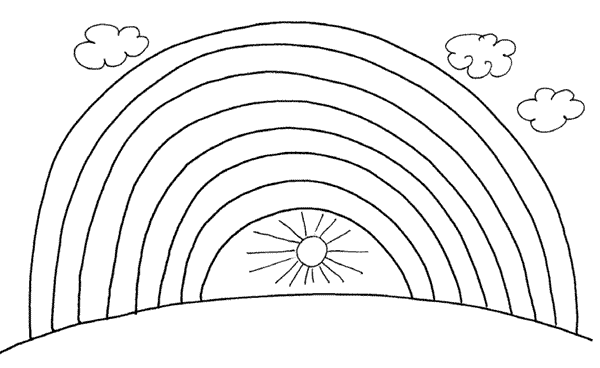
Eating the Colors of the Rainbow.

Depending on the age of the children they can either draw a rainbow themselves or you can make copies of a black and white rainbow to be colored. Here is a link to a rainbow that can printed off

http://www.kindbook.com/maths/7_rainbow_maths.gif

With each color of the rainbow have the kids name fruits and vegetable that match each color.

Some examples
    • Red: Apples, Strawberries, Rhubarb, Watermelon, Cherries, Raspberries
    • Orange: Oranges, Squash, Carrots, Cantaloupes, Sweet Potato
    • Yellow: Pears, lemons, peppers, bananas, pineapples
    • Green: Peppers, cucumbers, lettuce, spinach, Brussels sprouts
    • Blue/Indigo: Blueberries, Plums
    • Purple/Violet: Grapes, Raisins, blackberries
Challenge the kids to eat something new. Express that it's OK if they don't like it, but they still need to try it.  If the school allows it, bring in samples of the different colors.

For older kids, share with them the healthy benefits that veggies and fruits have. Kids like to know that carrots help the eyes.


Sunday, September 2, 2012

Personal Responsibility


Personal Responsibility is one of the main keys to good character development. When people do not acknowledge their own actions and feelings for good or bad, it creates a victim like mentality. By teaching children to recognize the dual nature within them, we help to end the cycle of “It’s not my fault!”
Read this Cherokee Tale to the class:


Two Wolves - A Cherokee Tale

A Cherokee is telling his grandson about a fight
that is going on inside himself.
He said it is between 2 wolves.

One is evil: Anger, envy, sorrow, regret,
fearful thinking, greed, arrogance, self-pity,
guilt, resentment, inferiority, lies,
false pride, superiority and ego.

The other is good: Joy, peace, love, hope, serenity,
humility, kindness, benevolence, empathy, generosity,
truth, compassion and faith.

The grandson thought about it for a minute
and then asked his grandfather, "Which wolf wins?"

The Cherokee simply replied, "The one I feed."

~ Author Unknown ~


Activities:

·      Ask the student for examples of when they have feed both wolves. Give your own personal examples. This helps the students understand that everyone struggles with emotions.

·      Have the students draw both of their wolves and list examples of behavior for each of their wolves.
·      What things can the students do to keep the good wolf well fed so that the bad wolf stays away?
·      Is it easier to recognize which wolf is active in other people or yourself? Why?

Thursday, August 30, 2012

Class Rules

It is important to set up class rules immediately. The character class has to become a safe place for students to share and learn.

Here are some basic ground rules:

  • Emphasize that the classroom (or where ever you are teaching) is a safe place. We are here to share and learn from each other.
  • Don't speak when someone else is speaking. Raise your hand when you want to be heard.
  • Respect other students by really listening to what they have to say. Don't judge yourself or anyone for what is said or shared.
  • No Names are to be mentioned. If you tell a story about what someone said or did, just say "this person" instead of their name.
  • NO GOSSIPING! Do not repeat what you heard about other students to anyone. You don't want anyone repeating what you have shared.
  • It is okay to talk to others about the lessons you have learned. By sharing character lessons, they too can become character teachers.

Saturday, August 25, 2012

Giraffes Can't Dance.

The book "Giraffes Can't Dance" written by Giles Andreae, is an excellent book to read during a Character Education lesson. The story and colorful illustrations are perfect;  they hold the attention of even Preschoolers.
 
The story details a giraffe, Gerald, who can't dance like the other animals. They all laugh at him and pick on his long legs and lack of rhythm. Gerald is sad and goes off by himself when a cricket shows him how to access his own natural dance and self expression. 


There are opportunities for discussion within this book to get the children to think with empathy and then relate it to themselves and others.

  • How did Gerald feel when all the animals laughed at him? Has anyone ever laughed at you for something? Have you ever laughed at someone and it made them feel bad?

  • Gerald found his own way to dance, though it was different, it was wonderful. Do you know of anyone who did things different from others? Have you ever done something different just because you like it? Were you ever made fun of for it?

Friday, August 24, 2012

Ice Breaker Day II

In the first icebreaker you had the students create name tents with three things about themselves and to answer the question: What kind of vehicle do you think I drive?

Hand the name tents back out to the kids and ask then one by one what type of car they think you drive. Compile the answers and ask the kids why they choose the certain type of car. Why did some choose a mini van, a 4-door sedan or a truck?

When you have the information, let the class know what type of vehicle you drive.  Then discuss with them, the idea of stereotypes.

The last class I did this with were tied between a mini van and a nice business type car. They choose the mini van because they knew I was a mom and they choose the nice business car because I was in high heels. Some choose a truck because they knew I had a mini farm.

The correct answer was a mini van. It gave us an opportunity to discuss how we judge people, maybe for the clothes we wear, the fact that we are parents, or where we live. It also opens up the discussion for times when they have felt they were stereotyped for good or bad.

Ice Breaker


Have a piece of card stock paper for each student. Choose light colors, you want to be able to see the writing on them from the front of the room.

·         Ask the kids to fold the paper in half to make a name tent. 

·         On the outside have the students write their name in bold pen/marker

·         On the inside have the student write the following things

o   Write 3 things about yourself

o   What kind of vehicle do you think I drive? (The answer for this will be used in Ice Breaker Day 2)

·         Complete one for yourself. Make it clear what you want the students calling you. I preferred Ms. Jenny, so this let the students know I wanted that versus Mrs. Schiltz.

·         Once the students have completed the activity, ask for volunteers to share what they wrote.

·         At the end of class, collect the name cards. Bring them to future sessions.


This activity has multiple purposes:

o   It allows you to get to know the students names and little things about them.

o   It gives the students information about you as well.

o   Upon returning to the class room – have fun with yourself and see if you can remember which name card belongs to the student. When you make a mistake, make light of it. You are then showing the kids that you are human, not perfect and that mistakes are OK, as long as you keep trying. Practice this each time you return to class until you have memorized the names of each student.

Thursday, August 23, 2012

The most important character trait of all... Respect

Each Character Trait that we try to instill in children is important, however there is one that I always come back to regardless of the lesson. RESPECT.

You might think, yeah I know... Respect for authority, Respect for your teachers, your parents, property etc. These are all great but the one that needs to be drilled into everyone is:
 
RESPECT FOR YOURSELF.
 
When you respect yourself, it is much easier to respect others. When you value yourself and your differences, you can then value the differences of others. By teaching kids to embrace who they are we help build a shield of self esteem that will help them navigate the world. 
 
Most of the lessons I have taught whether it is about citizenship or caring have always lead back to self respect. When you recycle you are showing good citizenship but you are also showing self respect because you are taking care of your earth and property.
 
 
"I will treat you like a gentleman, sir, not because you are one, but because I am." ----- Abraham Lincoln